Education
What is Price Banding? How it Works in Financial Markets
6 Minutes
Read
•
Apr 10, 2026
Understand price banding in financial markets, how it works to control volatility, ensure orderly trading, and enhance market stability.
LAST UPDATED:
April 10, 2026

In fast-moving financial markets, prices can change in seconds. Without control, this could lead to extreme volatility, panic trading, or even costly mistakes.
This is where price banding comes in.
.png)
Price banding is a mechanism used by exchanges to limit how far prices can move within a certain range, ensuring that trading remains stable, fair, and orderly. It is commonly applied in structured trading environments, including commodity markets, where price controls help maintain orderly trading conditions.
The Core Idea: A “Safe Trading Zone”
At its core, a price band defines a range where trading is allowed.
Let’s break it down with a simple example:
● Mark Price: $100
● Bandwidth: 5%
This creates:
● Lower Limit (Limit Down): $95
● Upper Limit (Limit Up): $105
In other words: All trades are expected to happen within $95 – $105. This range acts as a “safe trading zone” for the market.
How Orders Behave Inside the Price Band
Understanding price banding becomes clearer when we see how different order types behave.
1. Limit Orders: Not All Are Treated the Same
Aggressive Limit Orders (Immediate Execution Intent)
Orders that try to execute immediately outside the band will be rejected.
● BUY at $106 → Rejected
● SELL at $94 → Rejected
Why? Because they attempt to trade outside the allowed price range.
Passive Limit Orders (Waiting Orders)
Interestingly, some orders outside the band are still allowed, if they are passive.
● BUY at $94 → Accepted (waiting for price to drop)
● SELL at $106 → Accepted (waiting for price to rise)
These orders do not disrupt the market because they are not executed immediately.
2. Market Orders: Not Truly “Unlimited”
Market orders are designed for instant execution, but even they are controlled.
The exchange automatically converts them into:
● BUY → becomes limit order at $105 (upper band)
● SELL → becomes limit order at $95 (lower band)
This ensures that execution never happens outside the band.
Important:
● If liquidity is not available within the band → the remaining order is cancelled.
3. TPSL (Take Profit / Stop Loss Protection)
To protect traders from extreme mispricing:
● You cannot set TP/SL too far from the trigger price.
● Orders must stay within a defined percentage range.
Once triggered:
● The order follows the same rules as limit or market orders.
Why Price Banding Matters Banding Matters
Price banding is not only a technical rule, but a core risk management system used by exchanges.
1. Prevents Extreme Volatility
Price bands act as “speed limits” to avoid sudden spikes or crashes.
2. Protects Traders from Errors
Prevents “fat finger” mistakes (e.g., placing orders far from market price).
3. Ensures Fair Market Conditions
All participants trade within a controlled and transparent range.
4. Maintains Orderly Markets
Orders outside the band are validated or rejected automatically.
Visual Summary
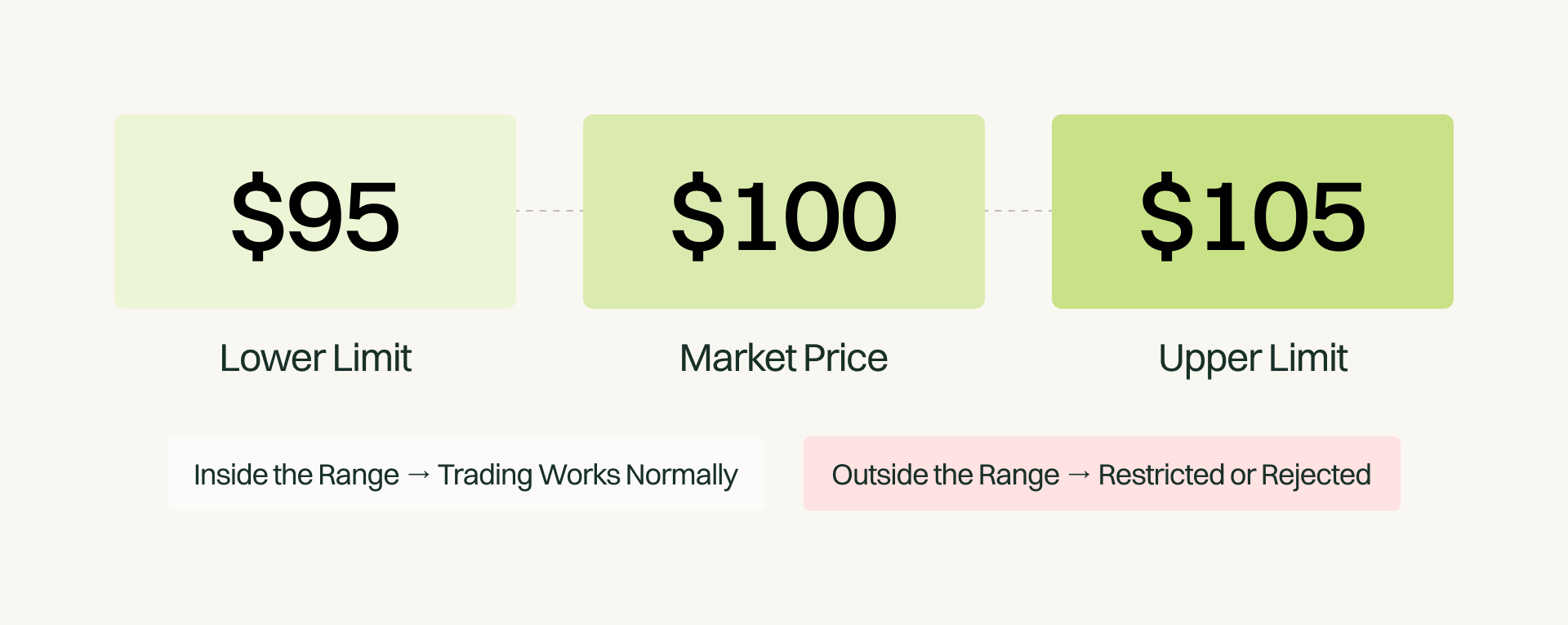
● Inside the range → trading works normally
● Outside the range → restricted or rejected
Final Takeaway
Price banding is a fundamental mechanism used by exchanges to keep markets safe and efficient.
It doesn’t limit opportunity, it ensures that every trade happens within a controlled and fair environment.
For traders, especially beginners, understanding price banding helps explain:
- Why some orders are rejected.
- Why execution may be partial.
- And how exchanges protect both the market and its participants.