Insights
Middle East Conflict: 8 Impacts on Gold and Silver Prices
Arta Anindita
•
2 minutes
read
•
Mar 17, 2026
Rising tensions in the region can trigger volatility across commodities, currencies, and equities, often prompting investors to turn to gold and silver as safe-haven assets.
Geopolitical conflicts have always influenced financial markets, and precious metals are often the first assets investors turn to during global uncertainty. The Middle East conflict is no exception. Rising tensions in the region can trigger volatility across commodities, currencies, and equities, often prompting investors to turn to gold and silver as safe-haven assets.
Understanding how conflicts influence precious metals helps interpret market movements and anticipate potential price trends.
Why Geopolitical Conflicts Move Gold and Silver Markets
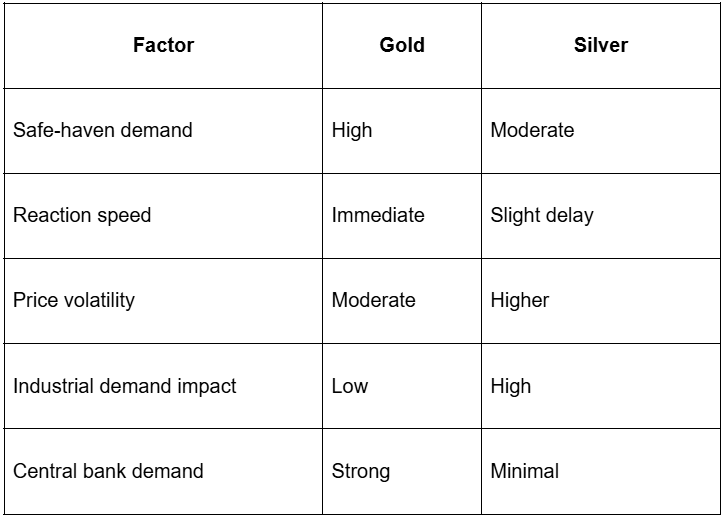
Gold has long been considered a safe-haven asset. When geopolitical risks rise, investors often shift capital away from risky assets like stocks into assets that historically preserve value.
Silver behaves slightly differently. While it also serves as a store of value, silver has a strong industrial demand component used in electronics, solar panels, and manufacturing. This dual role makes silver more volatile during geopolitical events.
History shows a consistent pattern: major conflicts tend to drive short-term demand for precious metals as investors seek protection against uncertainty.
8 Impacts of the Middle East Conflict on Gold and Silver Prices
1. Safe-haven demand usually increases, but price gains are not guaranteed
During geopolitical shocks, investors often rotate into gold first because it is widely treated as a global store of value. However, the latest price action shows that a stronger dollar and higher bond yields can partly offset safe-haven buying. Conflict may support sentiment for gold, but it does not guarantee a daily uptrend.
2. Currency volatility can strengthen gold’s appeal
Conflicts often increase pressure on currencies, especially when investors move into the U.S. dollar or reduce exposure to riskier markets. Gold tends to benefit when investors want a hedge against currency instability or purchasing-power erosion.
A stronger dollar may weigh on gold in the short term, while broader currency risks continue to support strategic gold demand.
3. Oil shocks are one of the clearest transmission channels
The Middle East remains critical to global energy flows. According to the U.S. Energy Information Administration, the Strait of Hormuz handled about 20% of global petroleum liquids consumption in 2024, and flows in 1H25 averaged 20.9 million barrels per day.
The current conflict raised concerns about potential supply disruptions, while Brent moved sharply higher. That matters because oil spikes can quickly raise inflation expectations and change the outlook for gold and silver.
4. Inflation-hedge demand can support gold and silver
When oil and energy prices rise, investors often reassess inflation risk. Gold is commonly used as a hedge in that environment, while silver can benefit as well, though it is usually more volatile.
The current conflict has already contributed to higher oil-price expectations and renewed stagflation concerns, which is one reason precious metals remain structurally supported even during short-term price pullbacks.
5. Central bank gold buying remains a major structural support
This point becomes much stronger when backed by data. The World Gold Council said central banks bought 863.3 tonnes of gold in 2025, still historically elevated, though below the 1,000+ tonnes pace of the prior three years. The same report notes that central-bank buying remained geographically widespread.
6. Investor risk aversion can shift flows away from equities
When conflict raises recession or stagflation fears, equity markets often turn more volatile. In that setting, investors may reduce exposure to risk assets and increase allocations to defensive assets, including gold.
Linked to the conflict, rising oil prices, inflation worries, and market volatility, reinforcing the case that gold remains part of a broader risk-management allocation.
7. ETF and institutional flows can amplify price moves
This point is especially relevant now. The World Gold Council reported that global physically backed gold ETFs added US$5.3 billion in February 2026, with holdings rising 26 tonnes to 4,171 tonnes, a new all-time high.
Even when spot prices pull back on a given day, institutional allocation can still be moving into the asset class. In other words, short-term price weakness does not automatically mean weak underlying investment demand.
8. Silver is affected not only by conflict, but also by industrial demand
Silver should not be framed only as a safe-haven metal. It has a much larger industrial component than gold. The Silver Institute said industrial silver demand reached a record 680.5 million ounces in 2024, marking a fourth consecutive annual high, supported by grid infrastructure, vehicle electrification, photovoltaics, electronics, and AI-related demand.
That means silver can react to Middle East headlines, but the global growth outlook and technology demand also shape its price. This is why silver often shows sharper and less predictable swings than gold.
Gold vs Silver During Geopolitical Conflicts
Key Market Indicators Influencing Precious Metals
Investors monitoring the impact of the Middle East conflict on precious metals should focus on several key indicators:
- Oil prices and energy market volatility
- Inflation data and interest rate expectations
- Central bank policy decisions
- Global equity market sentiment
These factors often determine whether price movements in gold and silver are temporary spikes or part of a longer trend.
Read also: Why Is Platinum Price Rising in Early 2026?
Conclusion
The long-term outlook for precious metals often depends on how prolonged geopolitical tensions become. Short-term spikes are common during major conflicts, but sustained price increases typically require broader economic pressures such as persistent inflation or monetary policy changes.
Gold and silver are often discussed in financial markets as diversification assets during periods of global uncertainty. While geopolitical conflicts can create sudden market movements, long-term price trends are also strongly influenced by interest rates, currency movements, and global economic growth.
Understanding the underlying economic forces helps investors navigate volatility more effectively.